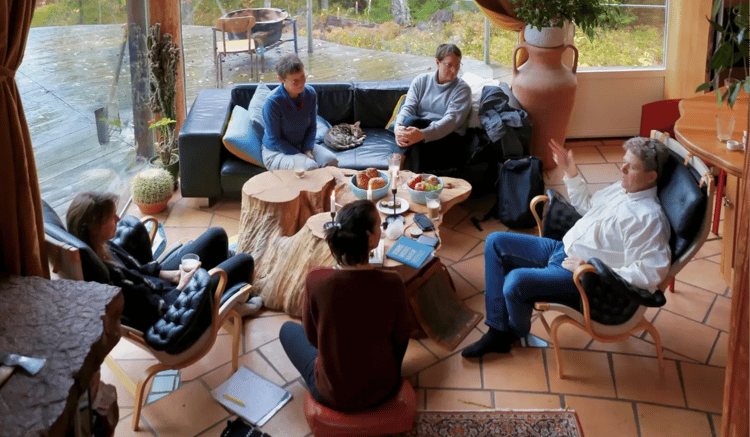
Advanced supervision group ISTDP autumn 2023
Welcome to the tutoring group fall semester 2023!
What is it?
Liv's supervision group is aimed at...

Something I have experienced personally and professionally too many times in my life is people's limited capacity to witness reality as it is and not through a filter of their emotions. This limitation not only provides incorrect information to the individual but can also do great harm to other people.
I would argue that this limitation is what gives rise to conflicts and division between people around the world, as well as to relationships and communities that may outwardly radiate compassion and understanding but which are in their nature rather very toxic. The term for people in these communities is "compassionate narcissists" and refers to behaviors of artificial kindness or altruistic actions primarily to strengthen one's own image and gain admiration. Unfortunately, therefore, to encourage the expression of everyone's feelings can have fatal consequences for people's ability to cooperate more effectively.
Such a statement from a clinical psychologist who works with people's emotional inner lives, I understand, may confuse some of you. Let me explain:
I am not saying that emotions should not be experienced and expressed. I am a very emotional person myself. But there is a big difference between being emotional and being emotionally driven without control. Emotions should be experienced and can, in combination with balanced contemplation, lead to wiser decisions, actions and expressions of your opinions. But you should avoid impulsively acting or speaking in public based on the first feeling that pops up within you.
Let me give you a likely emotionally provocative and extreme example. I hereby invite you to an exercise in putting your emotions and any political or ideological views aside for a moment in favor of open-minded analytical thinking. If that is not possible, you can simply refrain from reading further.
The extreme worlds have always interested me as I feel that it is in them that we find clues to certain human behaviors and a better understanding of social structures. Recently I have found an interest in the underground world that organizes fights. There is a certain fight club organization in Sweden that has received some attention and spread abroad recently. They organize fights without rules, similar to the fights that take place on the street. As you can imagine, the gatherings are not legal.
It is hardly surprising that the reaction to fight clubs from the average person is negative. But after observing the reaction to the fights in this fight club from other martial artists who operate within the legal, rule-governed world, I can conclude that even those who are part of a similar environment are drawn into emotionally driven reactions. Many impulsively condemn the fights as crazy, brutal, dangerous and unnecessary. Most fail to think beyond the immediate information that one's perception and emotions deliver.
It also becomes clear to me how easily one can influence our emotions and thus how we perceive reality with the help of film art and dramaturgy. Sure, violence is violence and more or less serious injuries are included. But violence is not necessarily synonymous with aggression and can be driven by other more complex reasons and represent something other than destruction.

Let me suggest an interpretation of the fights in this fight club that provides a different perspective than the brutal and the illegal:
Imagine that due to genetic reasons you have a strong explosive energy within you that has probably accumulated since various challenging events in your childhood. This strong energy has either been repressed and caused harm to yourself, or expressed and caused harm to others. (In later blog posts, I will share my thoughts on potential reasons why this explosive energy has accumulated and what it may be a symptom of from a societal perspective.)
Imagine that you are this person. Where are you going to take this genetically explosive energy within you? (No, regulated martial arts or other regulated but risky activities do not satisfy this very specific explosive energy. Due to genes and early programming from your upbringing, it feels at home in the extreme and will seek it out.)
Let me suggest answers to where you will likely end up: Hooliganism, prison after you have likely caused harm to others, lifelong confinement in a psychiatric hospital, or certain death.
Without placing any value on the existence of violence or not, I ask myself the question: Which alternatives are the least harmful to individuals and the least costly to society? The above-mentioned, or organized events at this fight club where people in need of raw reality-based fights gather and are allowed to exist based on the premises that they themselves agree to?
Probably not all, but many of those who participate thus choose not to engage in directly emotionally driven and impulsive violence where any random person can be harmed, in favor of a violence that has both decision-making ability, consideration and a mindset for consequences. Since they fight without protection, skill in martial arts techniques is required to deliver blows with a perfect balance of hardness and softness in strength. Those without skill but with the intention on completely destroying their opponent are weeded out.
What seems to be common to people who go there is a strong interest in getting their energy out through fighting, rather than a conscious desire for revenge or killing, which may be the driving force behind the violence on the street. Of course, more problematic people are also likely to participate, who otherwise contribute to problems and costs for society. I will return to thoughts in later blog posts to what the existence of underground fight clubs may be a symptom of in general and more specifically thoughts about masculinity.
My example of people's impulsively condemnatory reactions to this fight club is less about my views on violence or fight clubs themselves, and more about highlighting one of millions of other examples of similar situations in the world where people perceive reality through an emotional filter. As a person with both many academic credits and a lot of emotionally charged raw experiences of life itself, it worries me a lot that the average person has such a lack of ability to think analytically about emotionally triggering situations.
Feel your emotions fully. You must do so in order to keep your health and zest for life intact. But please, don't contaminate your surroundings with them before you know exactly what and why you feel what you feel. When you know that, your emotions can become a valuable contribution to your analytical and rational reasoning. Balance please!
Liv's supervision group is aimed at...
Liv's supervision group is aimed at...